

By: Michelle Young, Co-Editor-in-Chief
Content warning: Japanese imperialism, grooming
Park Chan-Wook’s filmography is filled with critical acclaim: he recently released No Other Choice (2025) and is also known for works such as Decision to Leave (2022) and Oldboy (2003). However, my favourite will always be the psychological thriller The Handmaiden (2016). Under heavy rain, the Imperial Japanese Army marches into a small alleyway in colonial Korea. Korean children sing behind them, and the Japanese army draws their weapons — the children scream and scatter. This is the film’s opening and sets the tone for the rest of the movie.
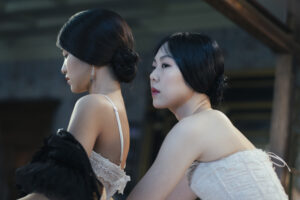
We are soon introduced to Sook-hee (Kim Tae-ri), who has been hired to trick the Japanese heiress, Lady Hideko (Kim Min-hee), into giving away her fortune. The Handmaiden rapidly unravels itself like an onion. Everyone has their own plans, and the film beautifully layers itself with various plots and secrets. As Sook-hee and Lady Hideko fall in love, the complexities of these plans and their relationship are slowly revealed to the audience over the span of the film.
Both Sook-hee and Lady Hideko are trapped: literally and figuratively. Literally, inside a colonial-style manor, which they can’t leave, and figuratively by a society shaped by patriarchy and colonialism — two oppressive ideologies. The men, the manor, and the influence of colonialism are far more sinister than the beginning of the film lets on.
The Handmaiden is filled with both the subtle and the grotesque, juxtaposing tenderness against violence.
There are subtle lies and outright violence of men who seek to take — they feel entitled to money and pleasure, only using women as a means to their desires. This is important, as the sexual relationships between men and women are always either violent, one-sided, or for an underhanded purpose. In contrast, the sex between women builds their trust and relationship.
A common critique of the film is that it pertains to the male gaze by including multiple scenes of lesbian sex. While the male gaze brings attention to how women are sexualized and objectified in film, this is the most misguided critique of The Handmaiden. Lesbian sex shouldn’t be stripped away from queer film for it to be acknowledged as legitimate representation — lesbians have sex. The way in which these sex scenes are portrayed and shot is important to the film’s plot and themes. Further, they defy typical conventions used when pandering to the male gaze. As the audience learns of Lady Hideko’s forced erotic readings, it is clear she holds these readings without ever enjoying them — and understandably so, as she was groomed to do them. She is forced to read about sex in such a repulsive and distorted view that her discovery of love and pleasure with Sook-hee is of genuine importance to her character. In using the same sex objects she was forced to read about, she reclaims herself — when for so long, she was made to perform for others. While some have complained of the lengthiness of the explicit scenes in the film, they are unapologetic and beautiful, with little focus on the body and emphasis on the women building intimacy.
The Handmaiden is cinematically stunning, carefully shot, and skillful in its timing: each scene is a portrait. The score is a masterful collection of strings, perfectly suited to the film’s suspense. While the film can be difficult and visceral, it is a testament to the power of intimacy and ambition, and empowers the audience to fight against the same structures it critiques.