

By: Ashima Shukla, Staff Writer
My eyes filled with tears as I watched Farming the Revolution at the SFU Surrey campus. In part, due to the power of ordinary people organizing against oppression. But also because of the surreal experience of watching this documentary so far from home — on stolen lands — as I reconnected with my homeland in collective gasps, giggles, and tears.
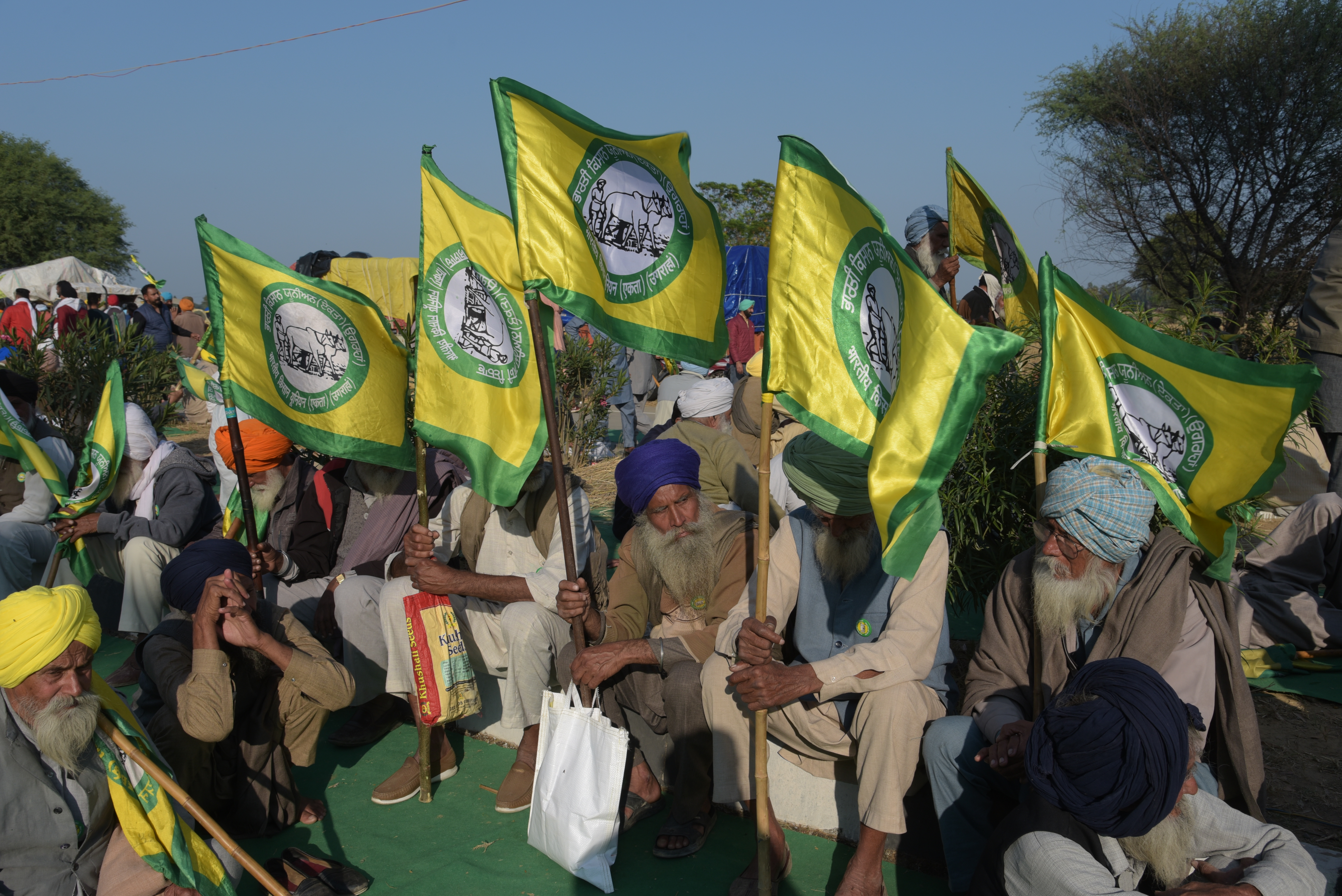
Directed by the acclaimed Nishtha Jain, the documentary screening and Q&A were co-hosted by the Hari Sharma Foundation, South Asian Network for Secularism and Democracy (SANSAD), and SFU’s Institute for the Humanities. Gathering fragments of the world’s largest protest movement in modern history, it follows the Punjab Bhartiya Kisan Union (BKU), the leading collective that has been organizing for farmer struggles since 1987. As the camera lingers on close-ups of sunburnt faces, the viewers are invited to unlearn, where the oppressed emerge not as victims of circumstance, but as stewards of their liberation.
Before the lights dimmed, Dr. Samir Gandesha, Director of SFU’s Institute for the Humanities, framed the screening as part of a larger discourse on dispossession — from land acknowledgement of our occupation of Coast-Salish lands to the genocide in Palestine to the farmlands of Punjab and Haryana. A reminder that the story unfolding on the screen was not isolated from the global matrix of capital accumulation.
As the title sequence rolled, we were drawn into that dialectic: the margins organizing against oppression, the subaltern writing history with their lives.
Distilling over 600 hours of footage into a cohesive narrative, Jain offers us an opportunity to partake in witnessing. Her work brings out the everyday textures of organizing: meals cooked in make-shift kitchens by the roadside, voices coming together to sing poems of solidarity, the ways people cared for each other in freezing cold nights of camping by highways.
Watching it, I found myself returning to Paulo Freire’s Pedagogy of the Oppressed. Freire writes that the oppressed must become “beings for themselves,” discovering their agency through transforming the systems of oppression. The farmers, long dismissed as passive subjects of state policy, appear in Jain’s film as intellectuals of the land, engaged in continuous critical reflection. We witness the farmers’ sophisticated grasp of political economy, laughing at the irony of working at Ambani’s Reliance malls while he profits from agricultural liberalization that is eroding agrarian sovereignty across the Global South. We witness how these insights lead the union to organize — with committees for cooking and tracking resources, with cultural forms like poetry and Punjabi language newspapers fighting against state hegemony.
Yet the film does not fully capture the mechanics of this extraordinary movement. We see meals and newspapers being distributed, but the how remains largely invisible. For example, who decided what stories to include in the paper? How were they printed and distributed? How did flour and tea rations make their way across hundreds of kilometres to feed the protesting farmers? These questions are the lifeblood of a revolution. And the documentary, for all its intimacy, leaves them unanswered. Instead, as it progresses, it falls into the trap of repetition, allowing stirring poems to carry the emotional weight of the movement without revealing the real labour that sustained the protests over 13 months.
Farming the Revolution leaves us with a vision. That the subaltern rise not as a momentary eruption but as part of a slow but persistent reweaving of social and political fabrics. That resistance, though imperfectly archived, endures anyway. That in every small act of solidarity, a seed of possibility waits for the right conditions, for the next hands to tend to it.