

By: Lucaiah Smith-Miodownik, News Writer
A new initiative aimed at stopping crime on the Downtown Eastside (DTES) adds another layer to conversations about the Vancouver Police Department’s (VPD) purpose and policy. In February, the VPD and Vancouver mayor Ken Sim publicized Task Force Barrage, a “long-term operation to dismantle organized crime networks and target predatory criminals in the DTES.” Some community organizations have expressed concern over the initiative, including Police Oversight with Evidence and Research (POWER). The Peak corresponded with Tyson Singh Kelsall, researcher-member and PhD candidate in SFU’s faculty of health sciences, and Molly Beatrice, organizer-member and research assistant in the faculty of health sciences.
POWER “is a community-based research project formed in July 2024 as a collaboration between researchers in SFU’s faculty of health sciences, members of Western Aboriginal Harm Reduction Society, and the Vancouver Area Network of Drug Users.”
Task Force Barrage is the newest link “in a chain of law enforcement initiatives aimed at criminalizing people who rely on public space during what seem like endless housing and toxic drug supply crises,” Singh Kelsall told The Peak. This “does nothing to reduce the violence of these twinned crises, and, in fact, pushes people already struggling into more desperate situations that are difficult or impossible to survive.
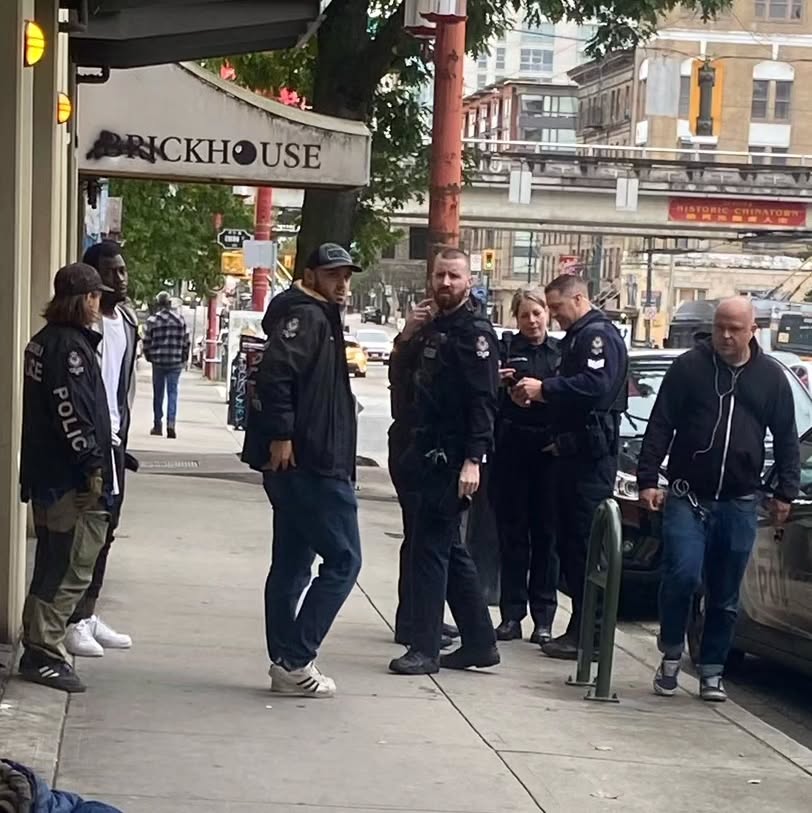
“Under Barrage, we have seen an increase in police officers harassing people on the sidewalk, and an increase in police officers riding horseback through the neighbourhood,” he added. “Every dollar used on Barrage could be used instead on providing safety and inclusion through shelter, rent subsidies, respite for people experiencing gendered violence in the face of provincial cutbacks, overdose prevention services, and meaningful, low-barrier civic employment programs in the community.”
The Task Force comes with a price tag of $5 million, though the Vancouver Police Board was unaware the project was green-lit until it was announced to the media. The order of events also raised questions for some regarding who is behind the task force. While the VPD originally labelled it a “joint initiative” between the force and the mayor, Sim claimed it to be solely VPD-led, contributing to confusion and concern.
“This is colonial violence in the name of ‘public safety.’” — Molly Beatrice, POWER organizer, SFU research assistant
Concern regarding the Task Force has allegedly come from within the VPD as well. In April, POWER reported that a source identifying themself as a VPD officer emailed the office of the police complaint commissioner with claims that the VPD was setting quotas of “2–3 drug arrests and charges a day” in the DTES. The email also alleged that inspector Gary Hiar, a leader of the Task Force, “openly lied to get promoted to staff sergeant.” The VPD told The Peak “the allegation is untrue.”
In response to the whistleblower, the VPD conducted an internal investigation, which yielded “no evidence of arrest quotas in Task Force Barrage.” Matt Harty, a superintendent with the VPD who investigated the claims, classified the numbers as “performance measures,” according to the Vancouver Sun. Such a response did not appease all concerns. “Performance measures and quotas are essentially the same thing in policing,” said former VPD superintendent Kash Heed.
“Quota or no quota, VPD sees expanded budgets to meet every type of crisis with further criminalization,” Beatrice told The Peak. She spoke to both police and government criminalization of people “sheltering in public space, [relying] on a toxic drug supply, [relying] on inadequate payments of income assistance, disability support, and seniors’ pay,” noting that in all cases, “Indigenous, Black, and racialized communities” are excessively targeted. “This is colonial violence in the name of ‘public safety,’” Beatrice said.
The VPD maintains a different narrative. The Peak reached out for a statement, and the VPD directed us to a May press release where staff sergeant Gary Hiar stated, “While we’re making life harder for violent offenders and organized criminals, we’re also working with the community to improve safety and build relationships. This work will require a sustained effort and there’s still a long road ahead.” The statement included Task Force metrics from February 13 to May 13, including weapons and guns (real and replica) seized. The Peak could not independently verify this information.
“The real fight for truth, justice, and change is coming from the survivors of police violence and families of those we’ve lost to police violence, like Justice for Jared and mothers,” said Beatrice.